How AI, 3D and Virtual Reality Are Transforming HSE & Safety Training
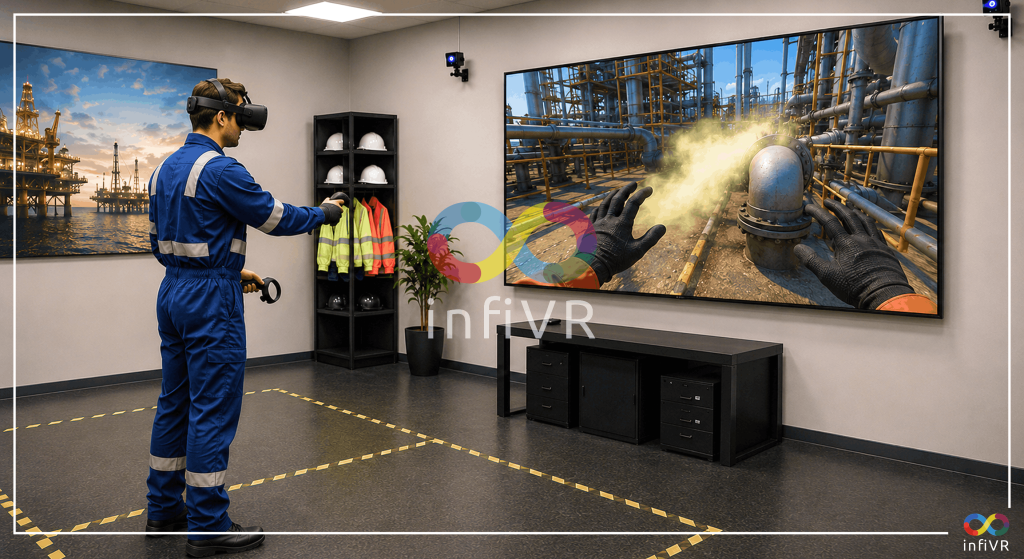
HSE training is important in industries such as manufacturing, construction, oil & gas, mining, power and infrastructure. Employees should know of hazards in the workplace, safety procedures and how to act in an emergency.
Traditional methods such as classroom sessions, videos and manuals offer useful information, but they don’t always allow employees to experience real workplace situations.
This is where AI, 3D, and Virtual Reality (VR) can help. Employees get to practice hazard identification, procedures and emergency response in a safe, realistic environment.
Simply put, safety training is evolving from just learning to actually doing and practicing.
What Does HSE & Safety Training Cover?
Effective HSE and safety training is about more than knowing the rules. It helps workers know about workplace hazards and what to do if things change.
A typical HSE & safety training program covers:
- Site Safety & PPE: Understand the site rules and wear the proper protective equipment.
- Hazard Identification: Recognizing hazards prior to the occurrence of incidents.
- Emergency Response: Know how to handle fires, leaks, equipment failures, and other emergencies.
- Fire Safety & First Aid: Raising awareness of simple emergency procedures.
- Safe Work Practices: Learning how to perform daily tasks safely and correctly.
- Environmental Safety: Understanding responsibilities for protecting people and the environment.
- Incident Reporting: Reporting incidents, near misses, and unsafe conditions to help prevent future accidents.
The goal is simple to empower every worker with the knowledge and confidence to spot hazards, make safer decisions and work safely.
Why Traditional HSE Training Needs a New Approach
Traditional safety training still plays an important part, but it doesn’t always get employees ready for real situations in the workplace.
Safety procedures can be taught in the classroom, in videos, and in presentations, but employees may not always have the opportunity to practice what they have learned or react to hazards in the workplace.
Research also shows the potential of VR-based training. A review of 52 studies showed that VR safety training was usually better than traditional methods for knowledge acquisition and retention.Another review of 136 studies on VR safety training considered practical outcomes, such as hazard identification and response.
It can be a challenge for companies with big teams or multiple sites to ensure training is consistent and to measure how well employees understand it.
That’s why more companies are looking for practical, engaging and measurable ways to deliver HSE training.
Transforming HSE Training with AI, 3D and Virtual Reality
HSE training is moving beyond presentations and videos. AI, 3D, Virtual Reality, and immersive technologies are creating new ways for employees to learn and practice safety in realistic environments.
They can recreate workplaces, equipment, hazards and emergency situations in a controlled virtual environment with 3D and VR.These environments allow employees to walk through, spot risks, learn safety procedures, and practice making the right calls.
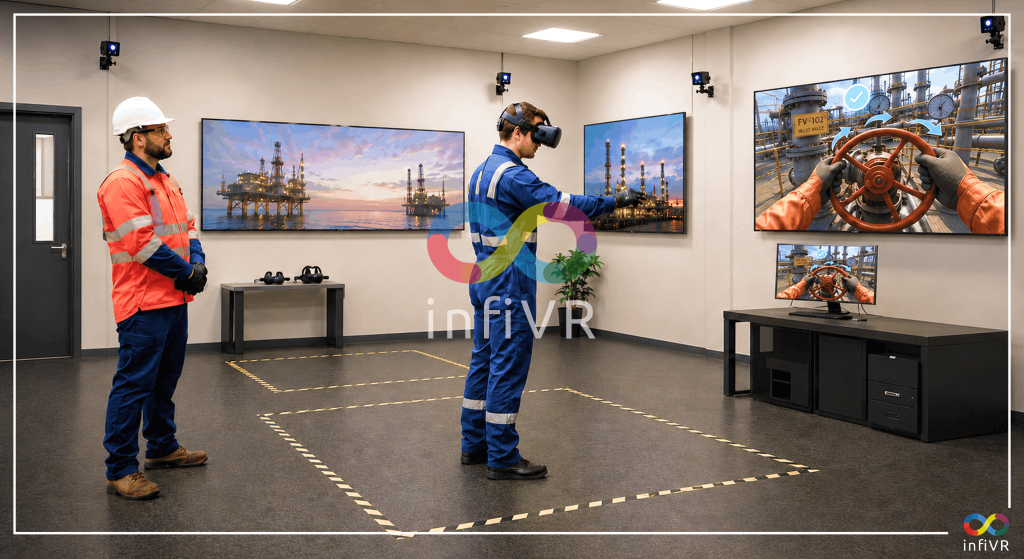
AI adds another layer of intelligence by analyzing learner performance, identifying knowledge gaps, and helping organizations understand where additional training may be needed.
Together, AI, 3D, and VR can make safety training more interactive, practical, and measurable.
What Can Employees Experience in Immersive HSE Training?
Instead of simply watching a safety video, employees can actively participate in realistic scenarios.
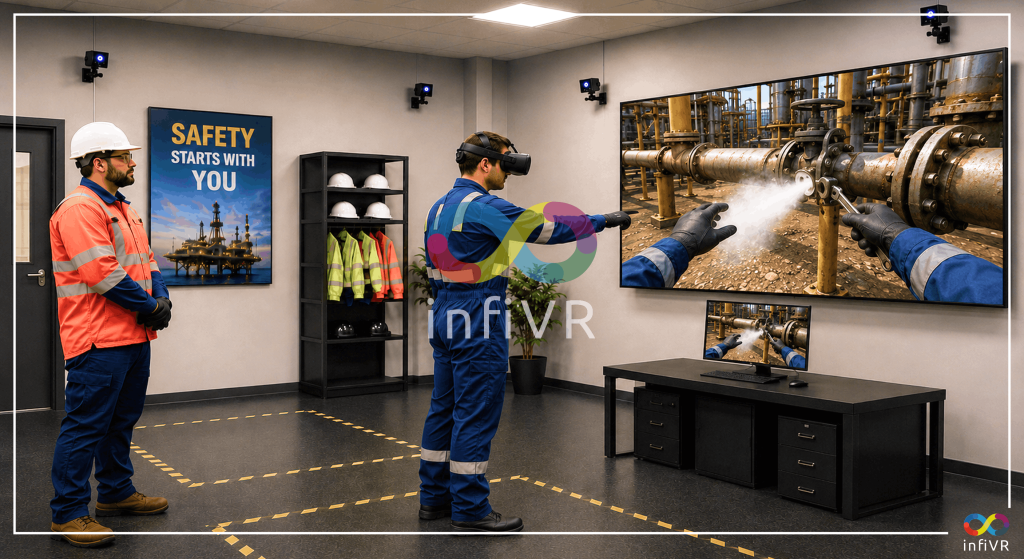
For example, they can:
- Explore a virtual industrial facility
- Identify workplace hazards
- Practice correct PPE selection and use
- Follow emergency evacuation procedures
- Respond to mock fires or gas leaks
- Recognize unsafe working conditions
- Practice safe operating procedures
- Make decisions in realistic scenarios
- Receive feedback on their performance
Employees can learn from their decisions in a safe environment and build confidence before applying those skills on the job.
How AI Makes Safety Training More Intelligent
The value of immersive training goes beyond the VR experience itself.
AI-powered analytics can provide organizations with insight into how their employees are learning and where they might need additional assistance.
Depending on the training solution, AI can help
- Monitor student performance
- Identify knowledge gaps
- Monitor training completion
- Decision making analysis
- Produce training reports
- Suggest areas for refresher training
This provides safety teams with more than just a record of training completion.It provides insights that can help them improve the learning experience and workforce preparedness.
Benefits of AI-Powered 3D VR Safety Training
AI-enabled 3D VR can increase the practicality, engagement and measurement of safety training.
- More engaging: Employees are active participants, not passive observers of videos or presentations.
- More realistic: Training can simulate real workplaces, equipment and possible risks.
- Safer practice: Employees can find themselves in high-risk situations and practice the proper response without real world consequences.
- More consistent: The same training experience can be delivered to different teams/locations.
- More measurable VR can measure performance. Including identification of hazards and response. Of 136 VR training studies reviewed, 42.65% evaluated the trainee performance.
Research also shows promising results: A review of 52 studies found that VR safety training generally outperformed traditional training for knowledge acquisition and retention.
For organizations, this means safety training can shift from simply telling employees to helping them to experience, practice, and apply safety skills.
Applications of VR Safety Training Across Industries
Safety challenges vary from one industry to another. With 3D, VR, AI, and immersive training, employees can practice real-world situations in a safe virtual environment before facing them on the job.
- Manufacturing
Case use: Virtual production floor for machine safety, PPE, lockout/tagout and emergency response training
Impact: Quicker onboarding and reduced disruption to live operations. - Construction
Use case: Experience with working-at-height, scaffolding, crane, excavation and electrical safety scenarios.
Impact: Workers can practice high-risk situations without exposure to the real world. - Oil & Gas
Use case: Simulate gas leaks, confined spaces, firefighting, and emergency evacuation.
Impact: Supports repeatable training and can help reduce physical training costs. - Mining
Use case: Training for underground hazards, heavy equipment awareness, evacuation and emergency response.
Impact: Safer preparation for challenging work environments. - Power & Utilities
Use case: Electrical hazards, high-voltage safety, substation access, emergency shutdowns.
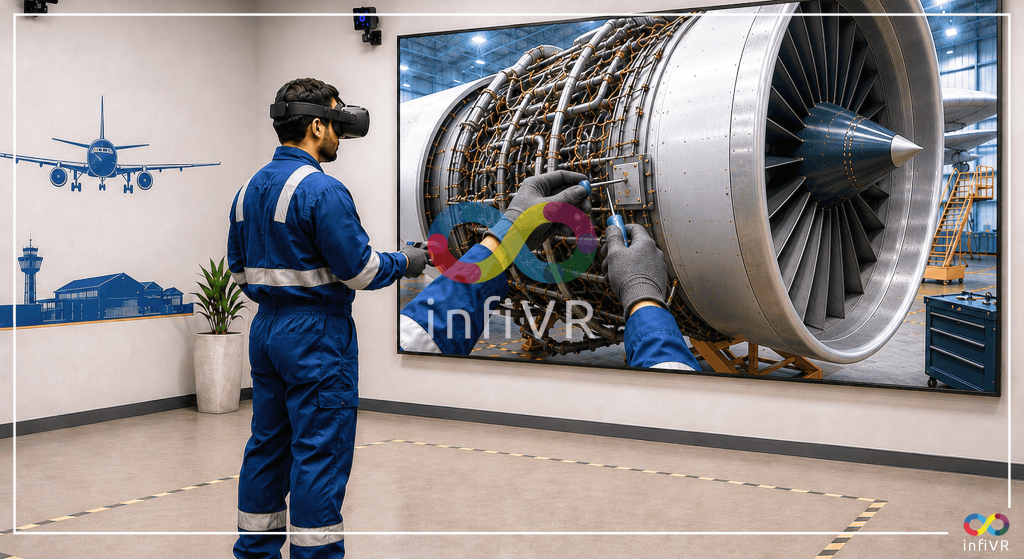
Impact: Practice critical procedures without risking live infrastructure. - Aviation & Automotive
Use case: Simulating aircraft operations, maintenance, production lines, machinery and emergency situations
Impact : More consistent training and faster familiarization for new employees.
Measuring the ROI of VR Safety Training
Training time, speed of onboarding, travel and setup costs, learner performance and training scalability are all factors that can be used to quantify the ROI of immersive safety training.
In suitable use cases, organizations can target outcomes such as: - Up to 30% faster onboarding
- Up to 40% lower training costs
- Higher learner engagement and knowledge retention
- Reduced training-related operational downtime
- Consistent training across multiple locations
AI-based analytics can also track learner performance, identify knowledge gaps and indicate where refresher training is required. The real value of VR safety training is not just the technology, it’s the ability to give employees realistic practice before the real situation arises.
How InfiVR is Transforming Industrial HSE Induction
InfiVR is the leader in immersive technology, VR and AI, providing realistic safety training to high risk industries. Its training solutions are based on real-life workplaces, equipment, processes and safety scenarios, allowing employees to gain hands-on experience in a controlled environment.
InfiVR has worked with organizations in industries including Suzuki, Renault and Volkswagen (automotive), QatarEnergy, Shell, Saudi Aramco (energy), Medline (healthcare), IndiGo (aviation) and DHL (logistics).
InfiVR combines immersive simulation with AI-based analytics in order to make safety training more practical, engaging and measurable.
The Future of HSE & Safety Training
Safety training is moving from presentations and checklists to realistic, immersive experiences that help people prepare for real-world situations. InfiVR helps organizations make HSE training more practical, engaging and measurable with AI, 3D and VR while allowing employees to practice safely before facing real workplace risks.
InfiVR is a global immersive technology company delivering AI-powered VR, 3D, and digital twin solutions for high-risk industries. Trusted by organizations including Petro Rabigh,
ADNOC, Saudi Aramco, ABB, Suzuki, and DNV, InfiVR creates scalable and measurable training experiences powered by advanced learner analytics. With a presence across the US, UK, Europe, UAE, Saudi Arabia, Qatar, Oman, India, Singapore, and Australia, InfiVR is helping organizations worldwide transform how people learn, practice, and work safely.
The future of safety training is immersive. InfiVR is building it today.
Tags: #InfiVR #HSE #HSETraining #SafetyTraining #WorkplaceSafety #IndustrialSafety #SafetyInduction #HSEInduction #SafetyManagement #EHS #EHSTraining #OccupationalSafety #HazardIdentification #HazardRecognition #EmergencyResponse #FireSafety #PPE #SafeWorkPractices #IncidentPrevention #RiskManagement #AI #ArtificialIntelligence #3DTechnology #3DTraining #VirtualReality #VR #VRTraining #ImmersiveTechnology #ImmersiveLearning #XR #ExtendedReality #DigitalTwin #AITraining #AIAnalytics #SafetySimulation #VRSimulation #IndustrialTraining #WorkforceTraining #EmployeeTraining #SafetyCulture #WorkforceSafety #ManufacturingSafety #ConstructionSafety #OilAndGasSafety #MiningSafety #PowerAndUtilities #AviationSafety #AutomotiveSafety #DigitalTransformation #FutureOfTraining #FutureOfSafety
About The Author
